

Scan QR code for Audio of Text
Author and Narrator Sarah McAullife
Music by XH
Triptych of Forgotten Light
A speculative response to Sean Hanrahan’s In the Presence of Beings
By Sarah McAuliffe (National Gallery of Ireland)
The warning signs were always there; plastic bottles, cans, wrappers, wipes and tyres piled up in large towers on the shore of our small town, where I once built sandcastles. The foam of the sea touching my ankles, a distant memory. Soaring temperatures, scorched earth all round. Green gardens turned brown, flowers to dust. The idea that the world I inhabited would one day become inhospitable was not difficult to imagine, yet I could not fathom such a possibility either. Fear or shame, I suppose. A certain relief came in knowing I wouldn’t live to see the end, the Earth’s final reckoning. For now, life continues underground in Neoterris. Subterranean environments like this began as survival shelters, temporary measures in the face of resource wars and extreme weather systems. A necessary respite for the ozone, wounded from centuries of carbon emissions.
That was four decades ago.
Today, these provisional burrows have evolved into fully functioning civilizations. I was eighteen when the surface closed in 2078; old enough to remember the smell of rain on pavement, too young to understand extinction. Now, I am in my late fifties and the sun is a rumour.
Here, light is engineered; soft bioluminescent panels mimic dawn and dusk cycles. Clouds and stars are projected, sunsets simulated. A chorus of turbines and air circulators forms the soundtrack of the city. Divided into five concentric strata, the city revolves around a central axis referred to as the “spire”, a vast vertical artery that houses transit links, air filters, communication cables and cooling systems. The band closest to the surface of Neoterris, known as the Ascendant Ring is made up of exclusive residences, research labs and government facilities. The temperature is programmed to imitate a time when Earth had regular seasons, the light soft enough to trick you into hope. Most of the population live in the layer just below, the Civic Belt. Its districts spiral outward in hexagonal clusters, each self-sufficient. Here, you can access hydroponic farms, schools, community centres and residential towers. Level three, the Archive Circle is where you’ll find me most days. Dedicated to arts and culture, the city’s museum, library and data vaults are located there. Artificial humidity is carefully controlled to preserve relics of a world that now exists only in memory and code. Below this lies the Machinery Loop, the industrial underbelly of Neoterris, where generators, aquifers and geothermal loops are constantly working to maintain its infrastructure.
The deeper you go, the city becomes more animated. The walls exhale warmth; the vibration of generators pulses like a heartbeat. Sometimes, when the ventilation currents shift you smell the faintest trace of pine resin or salt air. We are told its just chemical maintenance, but the older citizens, those whose memories of the surface are most palpable, call it “Earth’s breath”. The lowest level, the Abyss is rarely referred to. In fact, depending on who you ask it doesn’t exist at all. It is made up of a network of uncharted tunnels where early climate refugees settled before the city’s expansion plans caught up. Today, its inhabitants have been ostracised, denigrated as outcasts. They talk of the land above as if we can return someday. Having rejected neural integration, they are condemned to the void. Their lights are dim, their air thin. But their freedom is absolute.
I remember when I was a young girl seeking shade in the Memorial Art Museum, browsing its galleries and corridors for hours. With objects dating as far back as the 1500s, it felt like I made a new discovery every time I visited; one week it was a shield decorated with the head of Medusa from the 17th century, the next it was an Expressionist painting capturing the artist’s sense of dislocation and isolation in the digital age. My most vivid memories of life above ground are of my visits to the museum. Although a lot was lost in the transfer to the deep, my love of art stayed with me; something physically intangible, yet so substantial.
The Memorial Art Museum felt like a scared space, preserving the past, while embracing progression. Light poured through a glass roof, footsteps and whispers echoed in the galleries. The air smelled of varnish and the perfume of passing visitors. I was always resisting the urge to touch the thick drips of paint on canvas, the polished stone sculptures; to feel something of the artist’s process. If I could just enter the picture space for a moment, I thought. The longing to escape the world outside was overwhelming. I guess I got my wish; whisked away from reality to a place that people over half a century earlier would have never imagined.
Now I visit the Aurix, our version of a museum in the underground world. Here, there are no grand halls, everything is compact, hushed, efficient. There is no sunlight to illuminate the galleries – modular pods that can hold a few visitors at a time – only artificial fluorescence. Visitors move in slow procession, guided by AI docents, eyeing objects from the past and those made by artists, thinkers and designers of Neoterris over the last forty years. As the purported intention was to one day return to the surface, only so much was transported here and filling the gaps of what is missing will decline as human memory fades. Of course, there are books and data records, but to be in the physical presence of an artwork, to feel its aura is something that cannot be read, researched or imitated.
Last month, I visited Gallery 12, and I’ve been keeping a secret ever since.
A new projection had been programmed, a triptych of a kind I had never witnessed before in the Aurix. It triggered a flashback to one of my many trips to the Memorial Art Museum. I must have been about eight years old at the time. I was standing in one of the rooms of 18th Century Europe, gazing at a cloud of oval canvases in gilt frames, some depicting the likenesses of dignitaries, royals and intellectuals, and others of dreamy landscapes and figures in lavish costumes.
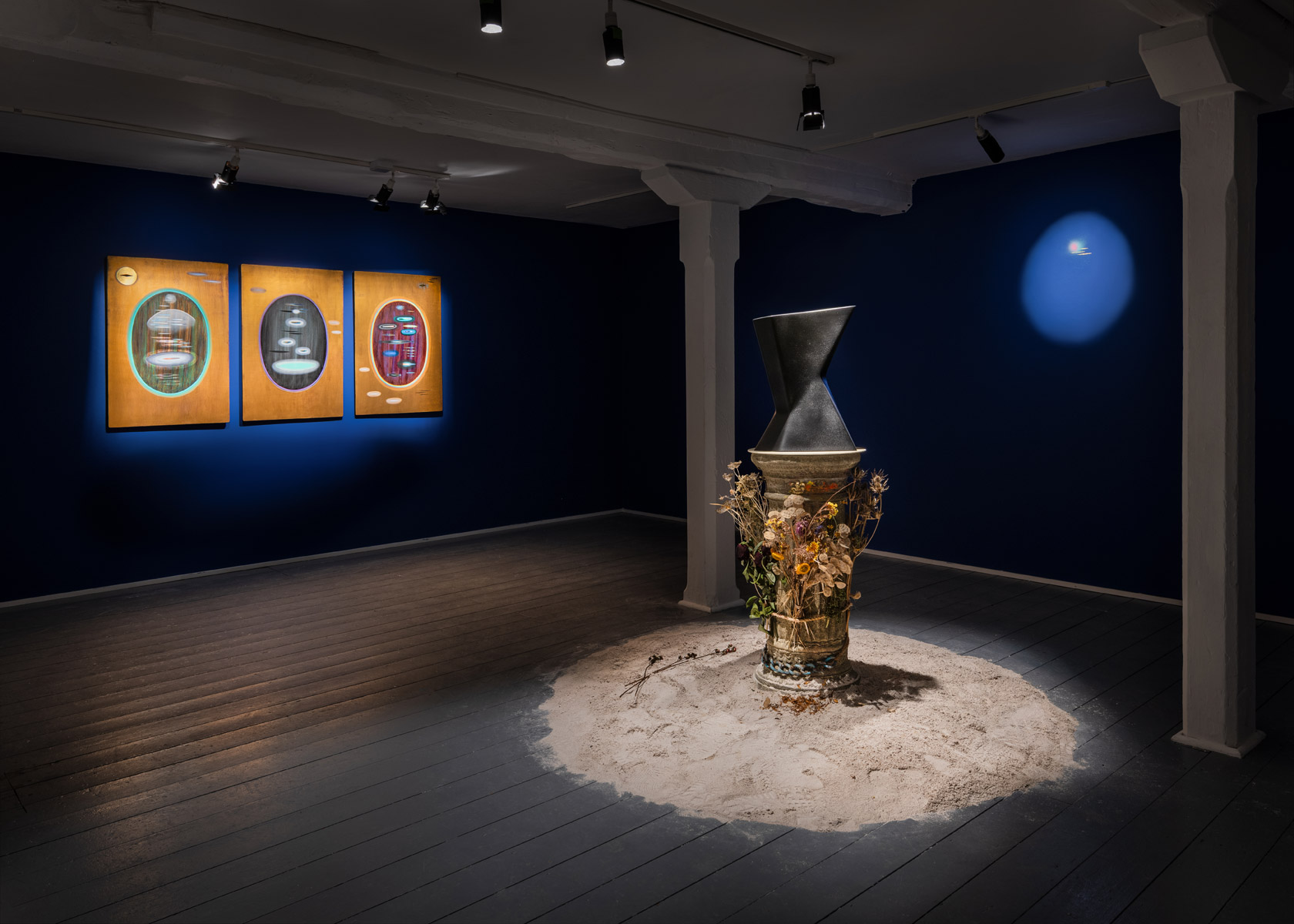
Before me were three rectangular panels suspended in the blacked-out room. They glowed with a subdued radiance, their gilded surfaces recalling the warmth of the sun. The central motif – an elongated oval – appeared in each frame as an endless void. Within these apertures drift luminescent ellipses, soft-edged and weightless, like organisms suspended in fluid or orbiting satellites. In the panel on the left, pale blue particles splinter the gold frame, hovering between emergence and retreat. A tarnished solar orb in its corner suggests the last vestige of daylight over Earth’s horizon. At its elliptical centre two forms, resembling a moon dipping below a pond of reflected twilight, float against dense veils of reds, browns and greens, reminiscent of a distant woodland. The central panel is more complex – a constellation of nested discs glide into the depths of a shadowy chasm; like a coded record of human departure from Earth’s surface, or an inward gaze, consciousness folding into itself. A pool evoking an algae lake occupies the base of the oval. It resists the magnetic force inhaling the atoms above. In the right panel, passages of blues, purples and greens levitate above a deep burgundy ground; every few seconds light ripples through them. The orb in the frame of the first panel is dwindling, the last of its light fading into a sphere beyond human vision. It has moved from the top of the left panel to the bottom right as if it turning on an axis. The letters X and H can just about be made out in the upper right corner, like the imprint of an artist. Yet, the maker’s identity feels as unknown as the many people who remained on the surface, now largely forgotten, consigned to the past.
Floating in the background was a panel of a different kind, less solid and constantly in flux; intersecting strokes of colour – blue, green pink – flashed across the room. It threw out shapes of varying scales, long enough to catch a glimpse of them before blinking, too quick to commit to visual memory. Gold particles exploded into space, falling around me like a meteor shower. Its crescendo came with the weaving of its forms into something three-dimensional, a sculpture that landed on the gallery floor, before it faded away a few moments later, folding back into its luminous source. It resembled the torso twist of a figure in contrapposto, rendered in hard edges rather than soft curves and it spiralled like a strand of DNA.
Together, these works assert themselves into the orbit of the viewer. The objects in the Aurix are usually described as passive, programmed to be looked at, not engaged with. But these pieces abound with a distinct dynamism that invites interaction.
As I turned to leave the room, I saw the central panel flicker. Something in me stirred, a vibration along the base of my skull. Could it sense me? I was observing it, and it was observing me, it seemed. My childhood impulse to reach out and touch the artwork came over me. The museum’s AI must have detected this and cautioned me to stand back, explaining that its interactive code had not yet been fully neutralised. I nodded and continued anyway. The surface was warm; it felt alive. For a moment, I thought I heard something, wind maybe. My fingers sank in, the room dissolved. All of a sudden, I was standing on grass, real grass, not some kind of reproduced texture. Soft, uneven, tickling the soles of my feet, it rolled out into a vast expanse before me. The temperature felt different to what I had ever experienced before; it was mild, pleasant even. Clouds floated like ships above me, their edges burning gold from the sunlight beyond them. The sound of waves crashing in the distance was interspersed with birdsong. It pierced something in me that I didn’t know was still there. I felt, small and infinite all at once. I was part of this landscape and it was part of me.
I was unmonitored, free.
For the first time in years, I felt something that couldn’t be calculated, transmitted or uploaded; longing and awe tinged with bewilderment and responsibility. I wondered if this is how the figure in Casper David Friedrich’s Woman before the Rising or Setting Sun (ca. 1818–24) felt standing before a radiant landscape; a transcendent moment that somehow felt personal, like life’s journey was being laid out before her. I’d never known of the sublime beyond the definitions I encountered in the Memorial Art Museum. Now, I felt I had tasted it. I bathed in a light that had long been forgotten, I breathed in air that was so fresh, it was dream-like.
Then, the ground shifted and the scene before me fragmented. I fell back through sound and light into the gallery. How long had I been gone? Couldn’t have been more than mere seconds, I thought. The surface of the panel was now cool, no longer porous. A voice murmured through my neural link: “Visitor 24 –S92. Interface protocol breached. Sensory contact prohibited.”
I stared at the triptych, still glowing softly. I realised then that each oval was a portal, not into space, but into time, into impressions of Earth before civilisation started to collapse. Figments of memory stored in light and pigment, waiting for someone to complete the circuit. Perhaps, this was the artist’s plea for action before it was too late, a call that was not heeded. But what of Earth now, after its prolonged intermission? Is there a chance it could feel this way again?
I have been visiting this exhibit ever since. Just yesterday, a glitch in the rightmost panel caught my eye. As I stepped before it I could see a faint reflection that wasn’t mine; someone standing in what looked like a studio, the kind I’ve seen in archived digital files in the library. Who could it be? The artwork’s maker, possibly. The label reveals nothing more than the triptych’s inscription – X.H. – and the year 2051.
I often wonder if other visitors have experienced this. I can hardly be the only one who’s been seized by the aura of this artwork. If so, why me?
I think my next visit will be to a friend in the Abyss. Older than me, with memories more vivid and earlier than mine, he has long balked at any talk of the possibility of regeneration on the surface for fear of the depths that lie beyond the already dark tier he occupies. But now, I have felt the air, I have touched the damp earth. His secrets are mine. Part of me is still in that verdant meadow. Perhaps that is the purpose of the exhibit; not to remind us of what we’ve lost, but to give us a chance to return.
I can’t go back to a life of imitation and surveillance so, for now, I’ll go down.