
Room Innate
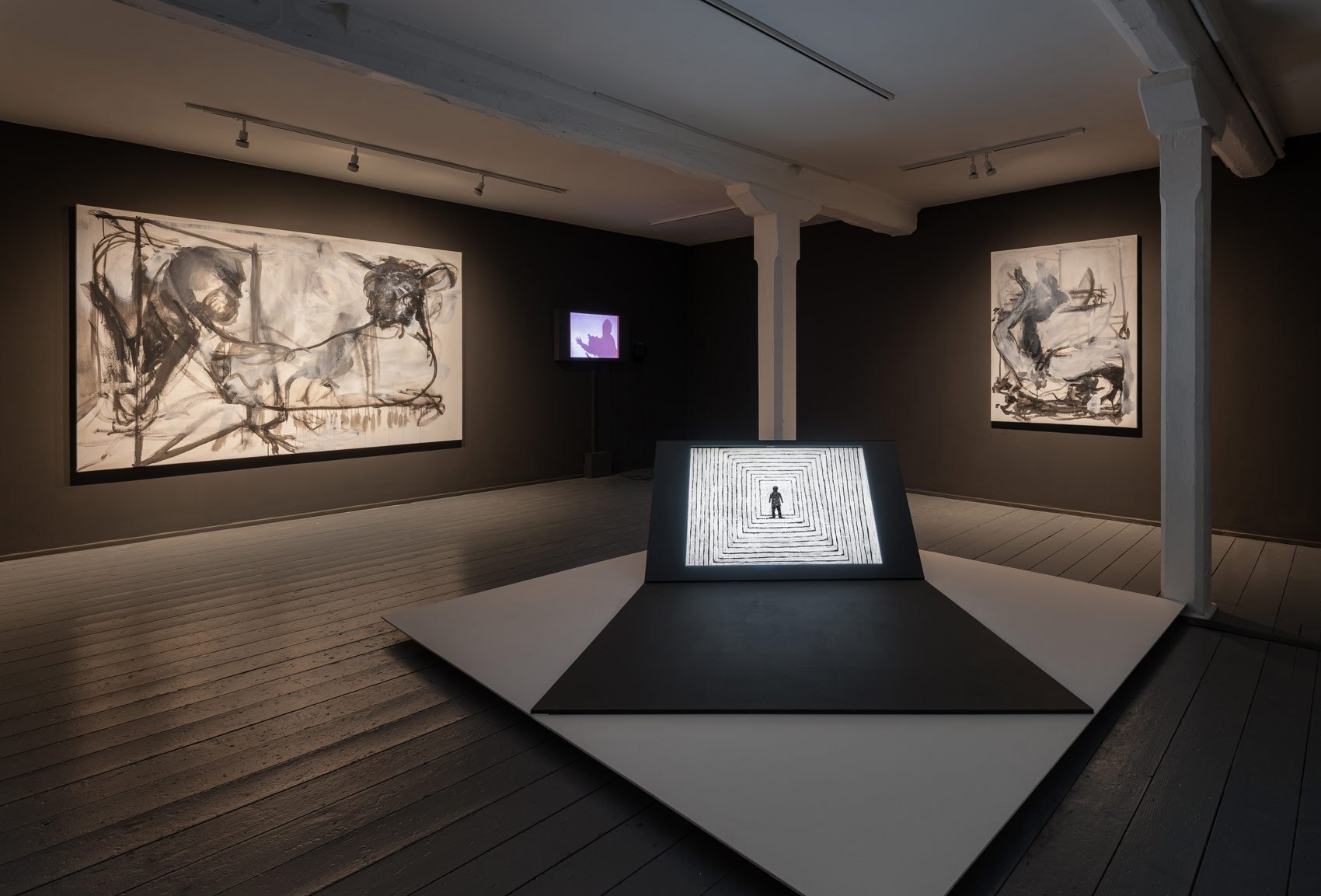
In a grey and darkened Studio 12, two large paintings illuminate the walls. They are monochromatic, in shades of grey and black that meld into their white backgrounds. The figures depicted, or lack thereof, appear to shift and slip through their story. The person in each, sometimes animal, is more gesture than being, more shifting impulse than fixed state. In one, a framed profile, its features darkened to us, examines a bull, whose head is turned back, hooves raised in flight as if singled out for sacrifice, its white celestial eye gazing out. The second painting is a collapse of a figure, legs pushed upwards and over their back, which is arched in impact against the ground. Faceless, they merge with a background of energetic marks that allude to an unknown setting of tables and walls.
In the centre of the room, a screen shows a looping stop-motion animation of painted figures that connect and move apart, transforming into a creature with a bull head and passing through frames of rectangular shapes, a line running ever along them. They create a dense surface, built up through painted animation, a singular plane running through the imagery. Arranged slanted in a box on the ground, the illusion of the screen’s silhouette is made by wood on the floor, as if the TV’s glow had a shadow itself. A second, smaller screen also occupies the room, sitting slightly apart from the other work. It shows the shadows of a child and an adult, sometimes dressed as animals, sometimes waving their arms as if conducting over a landscape, sometimes blending into kaleidoscopic patterns. On the left of the space, shelves hold small white clay objects in the windows, like the paintings’ subjects made manifest. They are undefinable figures, leaving certainty before we can grasp it. Illuminated, they create their true form in shadow.
A flickering thread runs through Room Innate, this solo exhibition of new work by Danny Foley that takes up play, memory and myth as ways of thinking through the self. It interweaves the paintings as a drawn shape and movement of the body; transforms across medium into the shadows of clay sculptures and a continuous line in stop-motion animation; and moves backwards in time to become re-edited archival footage of Foley’s own childhood. The elusive strand connects fragmentary locations to approach identity as something shifting rather than fixed, asking what might emerge when we stop trying to resolve the contradictions of the self and instead remain with what is unfinished, awkward and unknown.
In the myth of Theseus and the Minotaur, Ariadne’s thread allows Theseus to enter the labyrinth and find his way back out after killing the creature within. Foley’s works take up this story but unsettle its familiar moral structure. The Minotaur is a complicated monster, confined to the centre of a maze for being born of woman and beast, his difference rendered unnatural and his isolation making him into something that can only be encountered as a threat. He becomes a metaphor for repressed shame, destructive impulse and inner animal instinct. His killing is a triumph of the rational over these perceived flaws, a reminder to keep the unruly parts of ourselves contained and overcome. In Foley’s works he presents a fragile version of this shadow self, one that he does not seek to enclose. His figures and transforming entities are not simply that which is hidden and occluded, but selves which are never fixed, shifting continuously through multitudes that are all their own.
The movement of these figures and the shapes they make are taken from images of the artist’s own childhood play. Through this activity, the Minotaur is brought into proximity with psychoanalyst Donald Winnicott’s thinking on the holding environment and the role of aggression in the development of the self. For Winnicott, the holding environment provides the conditions in which an emerging self can experience the world without being overwhelmed by it. It is a space that does not seek to eliminate difficult impulses, but one in which they can be survived and integrated. Through this environment, the self can encounter and test the external world through a vitality that understands aggression as more than simply destructive. The figures in Room Innate are faint and incomplete. They move in ways that seem unfitting within social norms, taking forms we might recognise from the toss and tumble of childhood. They are less monsters than entities wholly of themselves, unafraid, and unconcerned with how they might appear. Instead of looking for an escape, they follow the thread of connection deeper into their inner labyrinth.
Foley gathers this line of thought in his titling of works. The painting Frame Work I (Starry One) takes up the Minotaur’s name in Greek mythology: Asterion. The contradiction of luminosity in the naming of a creature consigned to the shadows encapsulates much of the artist’s thinking. Foley’s Asterion, or Starry One, becomes a way of imagining the self as capable of holding its own contradictions. The awkward and unfinished parts of the self are not necessarily its failures, but part of the material from which it is made. Light, after all, demands its shadow.
Silhouettes and shadows operate throughout the work as both subject and method. There is an obvious relationship here to Plato’s cave, where shadows projected onto a wall become the limited images through which those confined within it understand reality. Foley’s shadows, however, are not false representations awaiting replacement by truth. They reflect the fading relevance of truth; they are more a trace of memory and action that is no longer present. They suggest that identity itself is partly formed through what remains, through accumulated experiences that can be recalled and reimagined.
The title Room Innate suggests both an interior space and something already contained within us. The exhibition returns repeatedly to the room as a space of childhood play, a place where the self can be tried on before it has been disciplined into recognisable forms. To play openly is to move between possibilities without resolution being necessary. Foley’s approach draws upon an understanding of thought as something that extends beyond the mind and into the physical world that surrounds us. Considered through play, this shifts the self away from a fixed interior being and towards an ongoing process, one that takes shape through bodies, objects, spaces and encounters.
Foley’s own childhood exploration of play is the subject matter of the accompanying video. Created by his mother, artist Collette Nolan, his play was once the subject of her artistic attention, and he was, in part, drawn into her work through the circumstances of childhood. Foley has since re-edited and revisited this footage, drawing upon the gestures contained within it across his paintings and sculptures. The thread between mother and son is therefore also a thread through time and authorship. Foley is both the subject and maker of these images, but not entirely their author. The childhood gestures precede his conscious artistic practice. They belong to a version of himself who was already making worlds through play.
The line from Collette to Danny moves across past and present selves without ever being a straight trajectory. What was once spontaneous gesture, generated through open play, becomes recollection and another way of understanding the self. The thread loops, frays and doubles back, complicating any expectation of a singular truth. In Foley’s works the room here is presented as a labyrinth in contradiction to that of Theseus. There is no monster to be defeated, nor a thread to offer a clear route back out. Room Innate, instead, is a thread that moves between bodies, shadows, memories and myth, and connects forms that might otherwise appear contradictory or incomplete. The room becomes less a site of enclosure than one in which these different selves can continue to appear. What remains is not a final image of who we are, but the movement between images as a gesture which is repeated, altered, forgotten and found again.
Katie O’Grady