
Reach out, pull Me closer
Exhibition text by Sarah Long
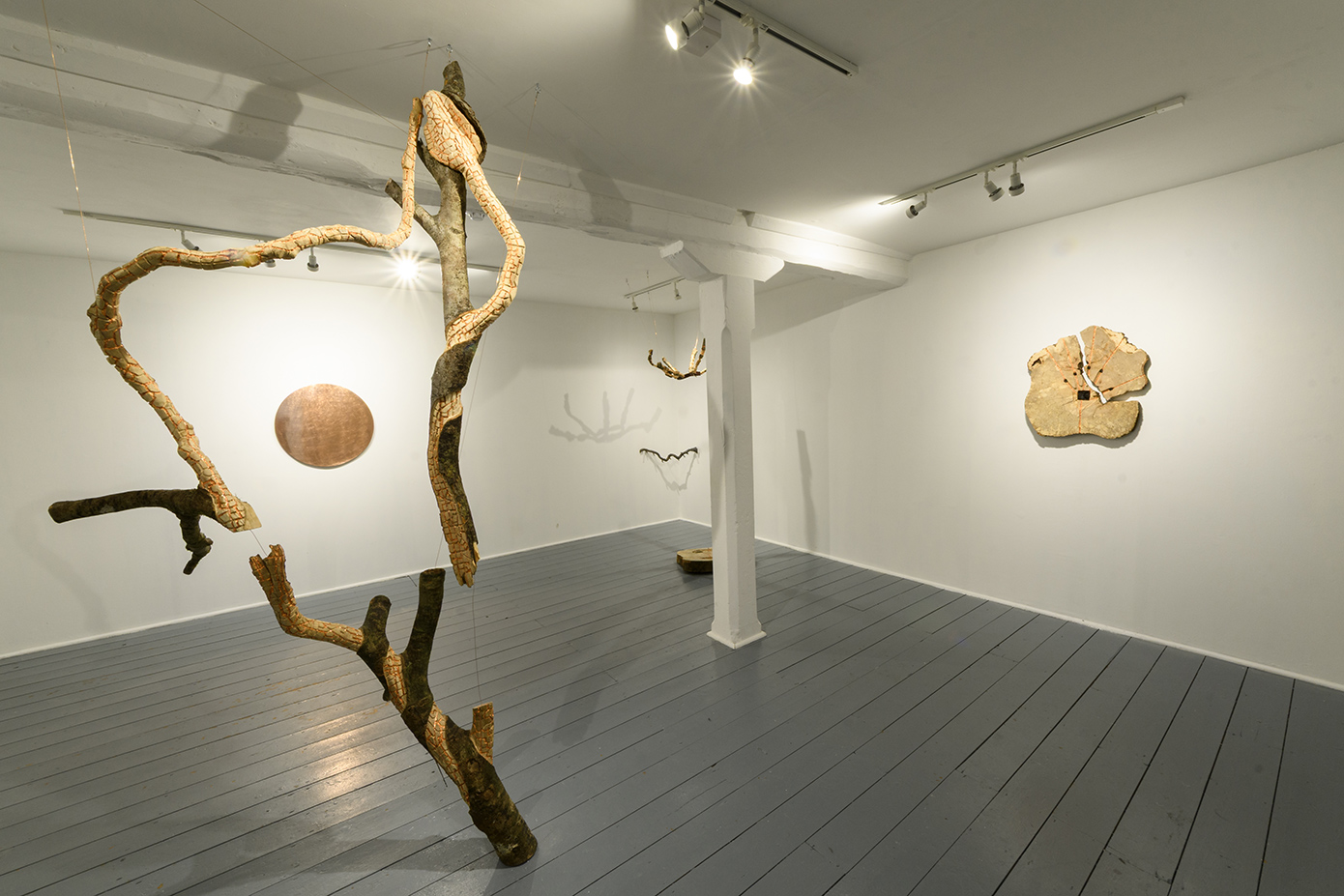
Murrough O’Donovan presents a series of interventions on a fallen beech tree in his exhibition ‘Reach out, pull Me closer’. Branches, bark and tree trunk are partially sculpted and scored to create a deconstructed–or constructed–landscape. A cascade of branches, arranged and fractionally worked upon, occupies the centre of the floor. It is this tension between O’Donovan’s physical inquiry into his chosen material and his observance of its natural qualities that highlights the show’s key concern: the delicate stasis between humans and their environment.
A branch with several kinks and knots is placed in the corner of the gallery space, as if cordoning off the area. The wood appears without modification, honouring the strange and multi various ways in which trees and organisms grow and develop with gnarly dips and divots. Held in place by the adjoining walls, the placement of this work calls to mind notions of trespass, private land and ownership. The balancing act of the branch suggests that human artifice cannot exert these fixed claims to its innate, wild integrity.
In Waiting, O’Donovan arranges a tree trunk underneath a headdress fashioned from wood and, most strikingly, a belt. The base of the sculpture contains grooves carved in the shape of feet, inviting the viewer to stand in place and wear this strange crown. The wood is attached to the belt perpendicularly, creating a religious visual akin to the ring of thorns placed on Christ’s head. This timeline collapses, however, in the network of fine lines that are grooved and carved into the branches. The geometric patterns, embellished with copper leaf, are reminiscent of Prehistoric art practices and designs. Our stories, religions and belief systems have always been intertwined in our surroundings. We impress upon our environment and our environment impresses upon us–there is a harmony to this.
The work can also be read alternatively, the belt at the centre of the sculpture can be understood as a symbol of dominance and control. The prioritising of the rational mind during the Enlightenment cemented the idea that nature was something that we could–and should master–and this outlook still informs much of Western society and ideology. The presentation of the work, echoes the apparatus of a Visual Reality headset, positioning the viewer inside the work whilst also underlining our disconnect from nature.
The interactive element of Waiting further complexifies the work, as the human impulse for ritual is explored. Quite simply, it is a pleasing thing to stand where someone stood before, the work puts the viewer in communion with their fellow audience and indeed ancestors: ‘Time flaps on the mast. There we stop; there we stand. Rigid, the skeleton of habit alone upholds the human frame.’[1] O’Donovan is interested in the ways we have historically interacted with nature, what traditions are intrinsic and primitive and bond us to our environment, and what instincts are destructive and remove us from these natural relationships.
A wall-based piece comprises a section of tree trunk that displays a handprint in its centre. The artist’s refrain, included in the exhibition’s mediation, resonates here: “Stand on their body, / Put your head in their arms, / Put your feet in their blood, / Stretch with them, / Reach out to Me, / Pull Me down, / Pull Me closer.” The wood is split into two sections, O’Donovan’s desire for connection is conveyed by the handprint that is carved across these parts in a symbolic gesture of the act of unification. This question of disconnect is interesting in an Irish context, in particular. Coillte, the Irish state forestry body, is often the subject of controversy and criticism due to its extractive approach to our woodlands, creating a monoculture rather than striving to grow and manage native woodlands that would see enormous ecological benefits. O’Donovan’s work illuminates the realities of how severed our society is from our basic life sources.
A copper plate, hanging on the centre wall of the gallery, acts like the sun overseeing the interplay of the sculptures. Its circular shape and solar proprieties point towards a continuum and the cyclical nature of all things. Life and death, creation and destruction–there is a balance to be struck between different forces. A balance, given our current ecological and Climate Crisis, we seem doomed to tip the scales on, until we are dragged down and embark on another terrible fall from paradise. O’Donovan seems concerned with discovering potential methods for us to commune with nature inside these cycles. As Virgina Woolf noted, indeed ‘rigid, the skeleton of habit alone upholds the human frame’ however as she preceded these lines in her novel, ‘s a cloud crosses the sun, silence falls on London and silence falls on the mind’.[2] We have our customs but they are shaped by our response to our environs.
Sarah Long
[1] Virginia Woolf, Mrs. Dalloway (1925)
[2] ibid.pp