
Curiosity Killed The Cat, But Satisfaction Brought It Back: Animal as Totem within the Work of Michaela McCann
By Lara Quinn
Most people are familiar with the proverb, ‘curiosity killed the cat.’ A reprimand prescribed to individuals who pry or ask too many questions, it is a playful reproach that warns of the human propensity for speculation and curiosity. Ironically, what is most curious about this saying is that one seldom hears the proverb’s succeeding, second line, ‘but satisfaction brought it back’. This line grants the cat back one of its nine, precious lives, revealing and rationalising the innately human desire for knowledge.
From biblical myths of the primeval temptation to the personification of a cat, these myths and proverbs make clear to us that it is the satisfaction of tasting the fruit of knowledge that at once satiates us and compels us to take another bite. However, it is also made clear in these allegories that this process induces an irreversible transformation of the self, that ultimately compounds our appetite for curiosity with the development of the human psyche.
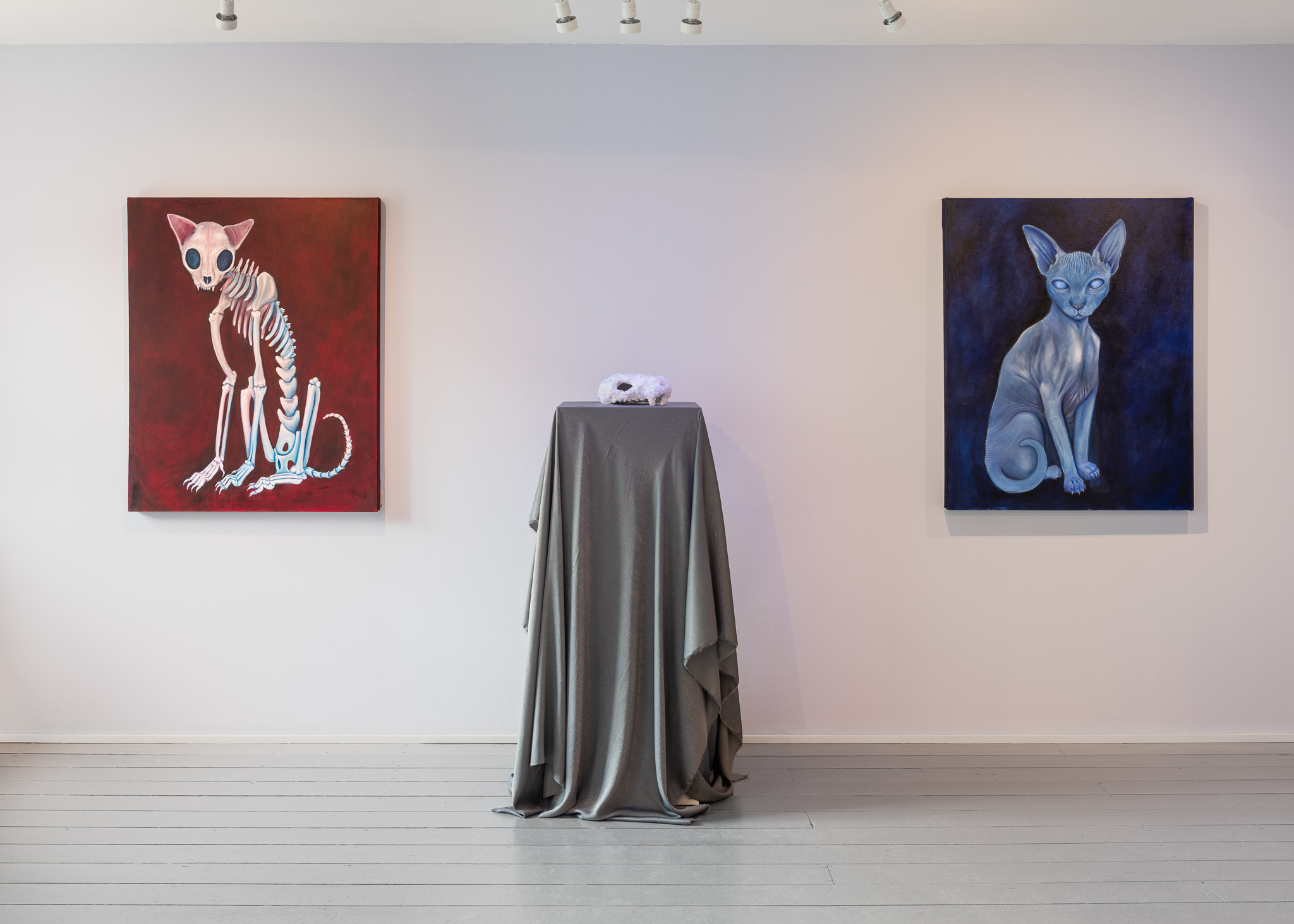
It is this proverb that emerging visual artist, Michaela McCann employs as the title of the central diptych within her recent solo exhibition, ‘Diverge’, at Backwater Artist Group’s Studio 12 Gallery. Upon entering the gallery space, the viewer is directly confronted by the two oil paintings, respectively titled, Curiosity Killed The Cat, and, Satisfaction Brought It Back. Epitomising the central themes McCann is investigating through this ambitious new body of work, these paintings associate the activation and fulfilment of one’s curiosity as an essential, archetypal process of growth, akin to the cycle of death and rebirth.
Referencing the proverb directly, the diptych portrays two cats, mirrored in pose yet inherently juxtaposed. Curiosity Killed The Cat, features the skeletal frame of a feline form. Its milky bones protruding from the guttural, red background against which it sits. It is undeniably a totem of death, indicative of both the historical past and a past version of oneself. Satisfaction Brought It Back, portrays what is seemingly the same cat in its more resolved state, coated in a replenished yet wrinkled layer of slackened skin that identifies the breed as a sphinx. Like the rings of an aged tree, the folds in the cat’s skin mark years of lived experience, manifesting physically the mental growth an individual endures throughout their life. The dichotomy that the proverb anchors upon is keenly exemplified through the mode of the diptych, which McCann further amplifies by mirroring both compositions in contrasting colours of red and blue.
Not only do these paintings explore themes of transformation and growth, but they also sustain McCann’s enduring interest in personal identity. However, diverging from the artist’s previous explorations of such subject matter, these paintings reveal a new and expanded focus of the Self that boldly rejects the representation of the figurative.
Instead, McCann harness iconographic devices of visual metaphor, specifically the personification of animals, along with more intuitive processes of painting, such as alla prima techniques that favour spontaneity, to portray what are ultimately self-portraits of the inner-self as opposed to capturing a physical likeness.
One can’t help but be reminded of the work of surrealist artist, Leonora Carrington (1917 – 2011), when considering the use of animals as totems of identity. American, art historian, Whitney Chadwick (b. 1943), describes Carrington’s practice as ‘an art of sensibility rather than hallucination, one in which animal guides lead the way’,1 in purposeful opposition against the sterile expectations of intellect and rationale that commanded many of the male-dominated art movements of the mid 20th century. She furthers this, stating,
‘Carrington’s animals identify the instinctual life with the forces of nature […] as symbolic intermediaries between the unconscious and the natural world’.2
Similarly to Carrington, McCann harnesses animals as a medium to explicate the unseen, unspoken processes of human nature, particularly those concerned with psychological transformation and growth. By representing these concepts through symbolic totems, such as a cat, the viewer is guided to look beyond the capacity of a physical reflection to access vicariously a symbolic representation of the self that conveys its ever-evolving cycles of identity.
In her essay, ’Beauty and/Is the Beast: Animal Symbology in the Work of Leonora Carrington, Remedios Varo and Leonor Fini’, American author, Georgiana M. M. Colvile reinforces the historical endurance of animals as symbolic tools for artists, writing that, ‘iconographic representations of both familiar animals and fabulous beasts are as old as human history’.3 From the thundering horses of Lascaux cave to the grinning hyena within Carrington’s ‘Self-Portrait’ (1938), McCann’s work is expanding upon a long established dialogue that ultimately evokes life’s most pertinent curiosity; who are we?
Chadwick negotiates representations of the self in relation to Surrealism, stating,
‘all Surrealist paintings are self- portraits, their sources internal rather than external, their imagery indistinguishable from the structure and functioning of their creator’s minds, their goal self-knowledge’.4
This is notable when considered through a viewing of McCann’s work, who describes the premise of her practice as an exploration of the human condition. This exhibition in particular serves as a testimony of this pursuit. When producing this work, McCann rejected a reliance on external research and references, in favour of a more automatic mode of making that engages more directly with the unconscious, archetypal content unique to her experience and memory. Just as the image of a hyena naturally evolved from an imaginary memory of Carrington, referenced in her short-story ‘The Debutante’,
the animals that appear within McCann’s work, such as the curious cat, can therefore be considered resonant manifestations of her identity also.
Themes of identity have long transfixed the minds of artists for centuries if not millennia. Particularly evident in the last 200 years, amidst advancements in modern technology and our understanding of human psychology, the internal environment has become just as tangible as the external. From the self-portraits of Frida Kahlo, who found solace from her physical disabilities in the use of her body as a vessel to represent the much more significant experiences of her internal world, to the sensational surrealist works of Leonora Carrington, whose figurative dreamscapes capture the sensation of living, in all its absurdity and all its curiosities, more honestly than the traditional renderings of realism and classicism ever could. Artists have made it their business to make the unseen seen, exposing the hidden and often very personal psychology of the human condition that ultimately binds us all.
McCann’s work responds directly to these conversations, expanding dialogues of identity and the Self through a modern 21st century lens that reveals our individuality as well as our commonality. Using her own devices of symbolism and visual metaphor, McCann manifests, onto canvas, the inner workings of the human psyche, painting otherworldly scenes that are at once familiar and foreign. The artist’s evident technical skill in painting realism is challenged by the surreal representation of sensationalised, dream-like content which ultimately triggers the curiosity and wonder that bewitches us all.
1 Whitney Chadwick, Women Artists and the Surrealist Movement, (London: Thames & Hudson), 1985, 77.
2 ibid., 79.
3 Georgiana M. M. Colvile, ‘Beauty and/Is the Beast: Animal Symbology in the Work of Leonora Carrington, Remedios Varo and Leonor Fini’, in Mary Anna Caws, Rudolf E. Kuenzli, Gwen Raaberg, Surrealism and Women, (London: The MIT Press), 1993, 159.
4 Whitney Chadwick, Women Artists and the Surrealist Movement, (London: Thames & Hudson), 1985, 66.