
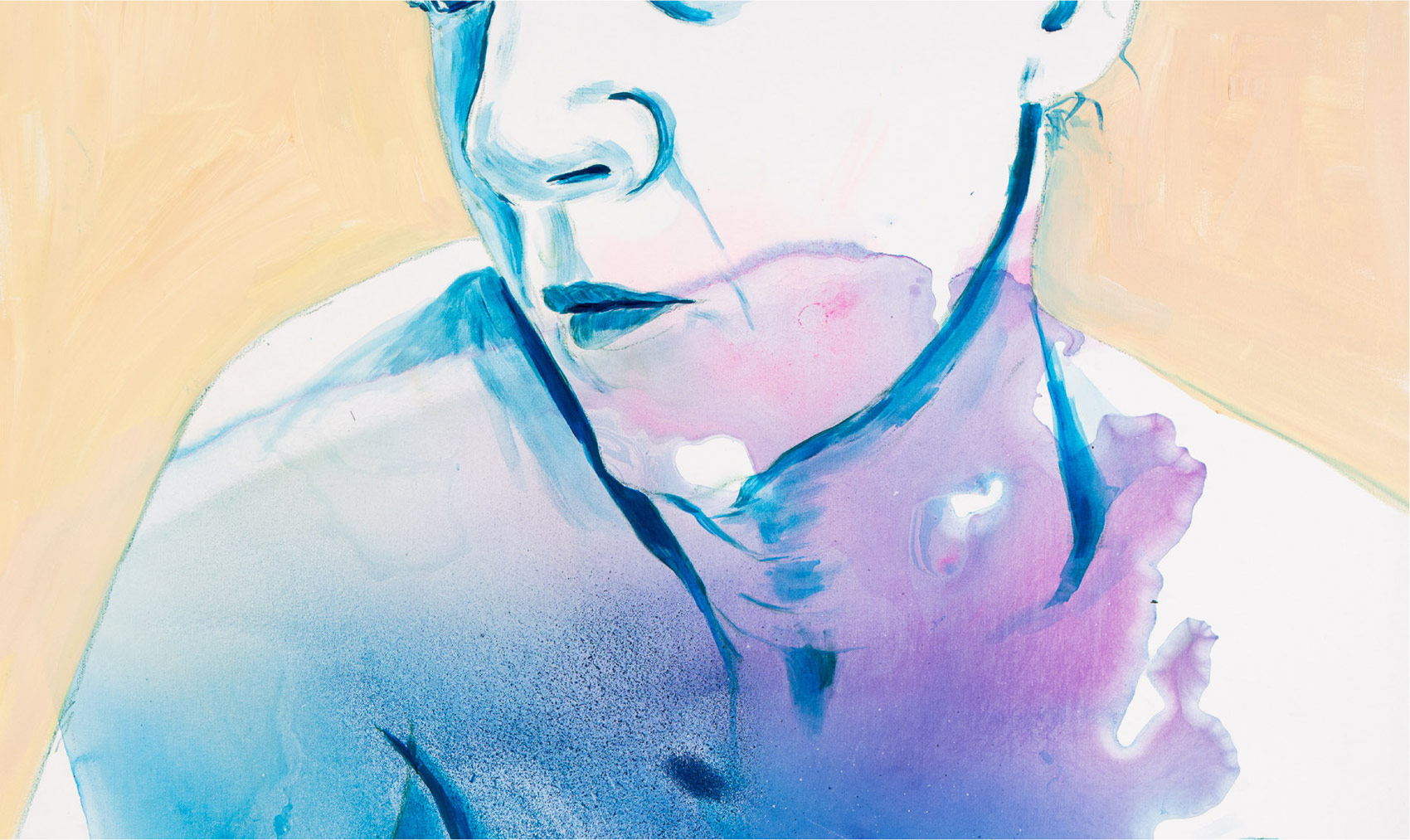
An Accumulation
We are always in a state of becoming. The body is an accumulation of time.
The sum of countless past selves
The pale seam on my knee from a childhood fall.
Like a slow moon rising.
Our skin holds us together.
It is a threshold.
It keeps us intact.
It remembers.
It protects our squelchy, fleshy innards but it is also a site where the world leaves its mark.
Our skin is porous, leaky.
It stretches.
It absorbs.
It bears pressure.
The canvas performs as a skin. Paint crawls across the raw canvas. Pooling, bleeding, drying, cracking. It records the history of its making.
Every mark remains as evidence that something happened HERE.
An exhibition is an accumulation. Of labour, time, thinking and making.
This exhibition emerged through Éadaoin’s and my conversations, with the studio visit at the centre. Éadaoin’s process-led practice treats painting as a reflective space where personal and shared experiences are negotiated. The act of making becomes a method for her understanding and a way to explore what language alone can’t express.
The nude is never neutral. It carries a multitude. In 19th century Europe, the female nude as a subject often appeared as a body arranged for viewing. The constraints of the canvas keeping her contained and disciplined, denied of any agency or complexity. Éadaoin is engaging with these inherited frameworks, questioning how she can reclaim the female nude, containing a multitude.
Laura Elkin speaks of the unruly body: a body that refuses to conform to society’s neat, patriarchal rules. She describes a body that expands beyond and in resistance to imposed culture, that rewards young, smooth, productive bodies.
It wrinkles.
It sags.
It scars.
It flushes.
It leaks.
It cannot permanently sustain the fiction of youthful perfection that Susan Sontag describes in The Double Standard of Aging. If every wrinkle is culturally understood as a “defeat,” then the aging body becomes unruly because it refuses to remain within those prescribed boundaries.
Paint does not always behave.
It bleeds beyond an edge.
It pools unexpectedly.
It cracks as it dries.
It leaves traces of undoing and redoing
It resists control.
The material itself becomes unruly. Gesture, accident and repetition become part of the work’s meaning.
A painting is an accumulation. The painting is a record of its making.
As every brushstroke records the movement of the artist’s hand, every wrinkle records a moment lived. Just like the material, a body can be understood as a process.
The paintings don’t simply ask us to accept ageing. They invite us to see it as material and process. Once we stop measuring the body against an impossible ideal of permanence, its changing surface becomes a site of endless mark-making. A living canvas.
Kim Crowley