
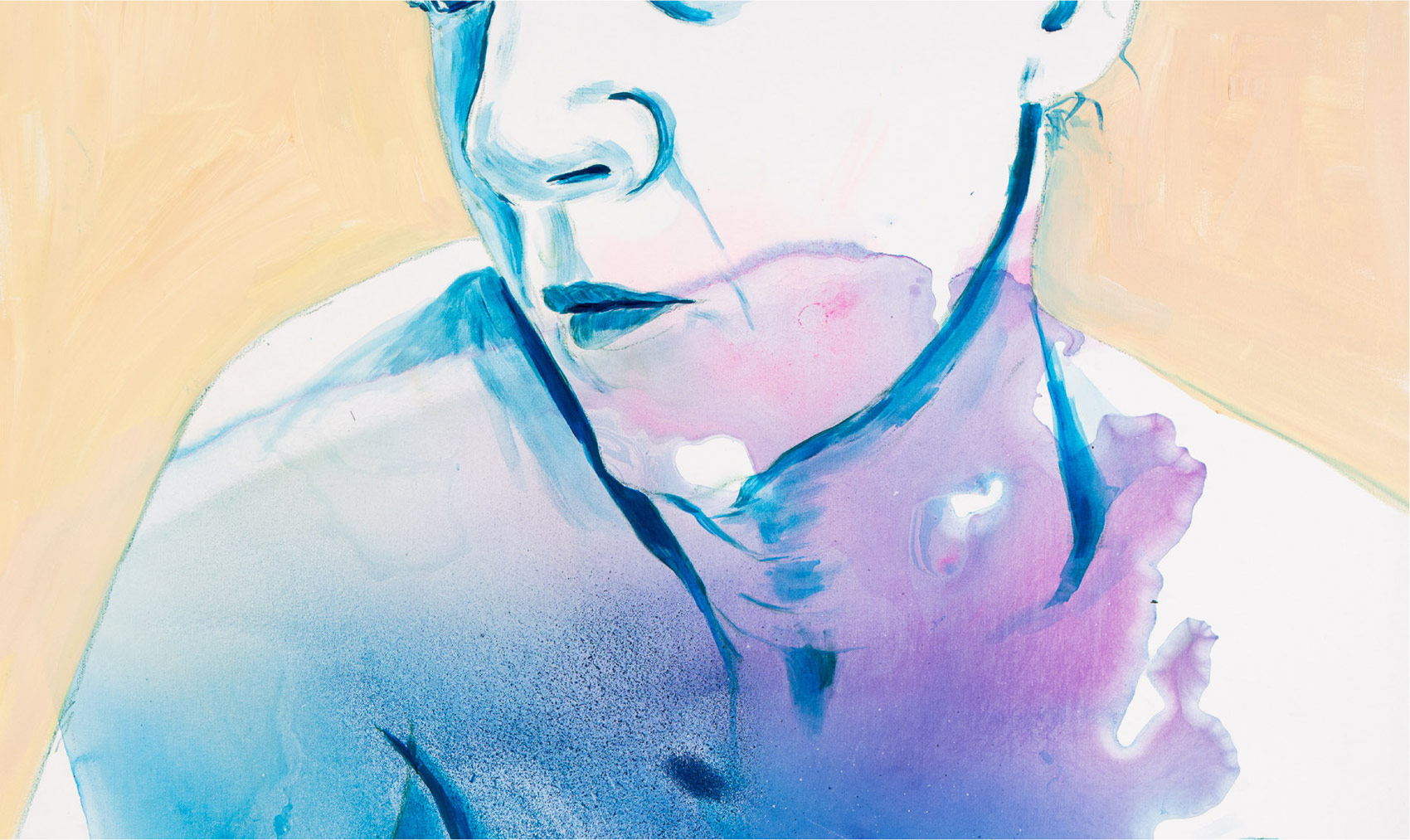
A Woman Approaches the Canvas
A woman approaches the canvas and says
– what can you hold?
When Éadaoin Glynn began to paint, it was with water that pooled and pigment that travelled and stopped
on tilting
with gravity
under attention
with curiosity.
It was with an open-ended question addressed to the materials in her hands: what can you hold? Her early paintings were abstract canvases formed in a confluence of experiment and faith, a kind of playing, with instinctive intent, mostly on raw fabric, unprimed. It was an exploration launched under an internal invitation to pursue untrammelled discovery. There might also have been a kind of hiding, or necessary subconscious occlusion of self, at the heart of it.
A woman approaches the canvas and says
– hold me.
She started painting self-portrait heads – ‘tronies’ her mentor Vanessa Jones at the RHA School called them: a Dutch art historical term for studies of human facial expression and character. Then came bodies – based on images of her own body at first, because hers was the model available. And looking at this body, she noticed the imprints and residue of hormone replacement therapy patches, their impacts left on the skin. She painted more bodies, their forms no longer intended to represent only hers, although she remained her own model. But the bodies in these paintings came out small, a little distant, and the head paintings had been big, physically present, close-up. So she moved her focus in, to the female body parts, and got really close up.
A woman approaches the canvas and says
– hold this.
Hold these tears. Hold this sweat. Hold this transformation. Hold this body, these limbs, this head. Hold these folds of flesh. In a trio of paintings by Éadaoin Glynn, belly meets thigh in the deep crease of a torso landscape, moon-like breast touches curve of leg in a gentle lunar landing, and unseen lips approach upper arm in a breathy self-kiss.
A woman approaches the canvas and says
– hold us.
There is a spectrum, from deep darkness to potential light in the responses of the women who answered the artist’s anonymous questionnaire about their experience of menopause – before, during, and long after. It is to be found too in Glynn’s own experience of living in a female body, mid-life. The words that emerge travel the same path as a description of the process of labour and childbirth might.
Chaos. Anxiety. Loneliness. Grief. Exhaustion.
Pain. Threshold. Transformation.
Presence. Power. Freedom.
A woman approaches the canvas and says
– show me
– let me in
– meet me here
– let go
– let’s go.
This new body of work reframes female midlife as another beginning, an uncharted sea to be navigated, an invitation to find a new way to submerge and resurface after irrefutable, unavoidable change, an opportunity to travel with intent towards the next, natural thing.
With a background in studying and analysing literature, Glynn began with words that appeared in the head, but came from the body. Bodily experience was translated into language by the women who answered her survey, and she responded with painterly gestures in which new narratives gather and coalesce. Body to head to hand. Head to hand to paint. Glynn treats pigment as a conduit for memory, kinship, experience – what can it hold? Hold this.
Her survey asked women to describe their experience in an image or a phrase. Among the most used were the words anxiety, exhaustion, brain fog, invisible, insomnia, rage, dismissed. They wrote invisible, grief, depression, loneliness, fear, shame, isolation. They wrote of weight gain, itchy skin, palpitations, night sweats, joint pain, hair loss, flooding. They wrote the words transformation, misunderstood, a shadow of my former self.
This small show, curated by Kim Crowley, takes its title from a book by Susan P. Mattern that seeks to dispel menopause myths. ‘The Slow Moon Climbs’ at Studio 12, Backwater Artists in Cork city contains eight paintings, a selection from Glynn’s larger body of work about the corporeality of female ageing. The title speaks of an upward trajectory of laborious evolution, natural cycles, a measured change of self.
Glynn is a persuasive colourist with faith in her process. She moves between conscious forms of decision making – aesthetic, instinctive, practical – and deliberately surrendered acceptance, as she makes her work. Pigment has its own intelligence. Pink leaves a feathery mark, blue tends to marble. As the water evaporates, acrylic leaves tidemarks. She begins with canvas flat on the floor, lets osmosis, diffusion, permeation do its work. Splotching, spreading, seeping, weeping, the paint mimics the body mimics the paint.
Lying on a bed, too hot, the woman in Metamorphosis or a Snake Shedding her Skin, is a mermaid, a chameleon, a shimmering djinn. She is drowning inside, submerged in a tide that rises within, figuring out how not to sink, remembering how to swim. Watermark, Seepage, Tidelines are the titles of paintings made in response to the women who reported feeling underwater, drenched, adrift.
Her post-reproductive life is often much longer than a woman’s physically reproductive phase, that evolutionary side-quest with deadly inherent risk. Childbirth is one of the most dangerously unpredictable things you can do with your body, or your body can do with you. The healthy end of fertility might be cause for celebration if it was not also labelled by patriarchal structures as a loss of worth, an early death; and if it was not frequently accompanied by the symptoms Glynn’s paintings visually investigate.
In her studio, monochrome experiments in pink operate like a sequence of animation stills, capturing a movement: the application and removal of a hormone patch. It’s the angle that reminds us of the camera, that other lens or screen though which we all see each other, and look at ourselves, now. There has been a move in the 21st century from fleeting mirror glance to camera-capturing as an everyday tool for measuring self.
A woman approaches the canvas and sees
that she has employed cinematic cropping to bring the bodies that emerge closer, to allow them to occupy the full space. Cheek to screen. Pigment to breast. It is as though the female body is approaching the surface of the work, from inside the work. She is meeting us at the surface of the painting. She comes towards us, twisting, turning, contorting. Or is the camera zooming in? Who is approaching who? Who is considering, beholding, paying attention, to what bits? Are we staring at her, or is the woman looking at herself? She invites us to look as she turns her head away and meets us instead with her feet, her mouth, her chest. It is as though she’s video calling us naked from the bath, where contemplation and nudity collide in a relatively rare encounter with our whole physical selves. She is about to reach out to turn the camera off.
Glynn still often begins often with abstraction, working with primed or raw canvas, experimenting with the science of absorption and resist. The parallels between her subject and her methods here are clear: change can be approached with an attitude of observation and curiosity; some outcomes can be controlled but they are also the result of environment, biology, physics, cellular behaviour, destiny inherent. Emotions cannot be removed from physical experience. There is learning and love to be found even in the uncontrollable bits. The woman in the painting Blue Cloud hugs her knees, tilts her head, glances to the side. She is living with, while contemplating, all of this. Whatever is happening inside her seeps and spreads, attempts a takeover, invites symbiosis, insists on a merger, before reaching some kind of internal and external equilibrium. It is asking her to carry on with what’s next. Is it overwhelming? Often, it is. Might it contain incredible power, and real beauty too? Yes.
© Cristín Leach 2026